


West Nile virus (WNV) Detection in Los Angeles County

West Nile virus (WNV) activity has increased across Greater Los Angeles, the state of California, and much of the United States. Within our service area, we've already detected 78 WNV-positive mosquito samples and 28 WNV-positive dead birds — more than at this time last year. The increase may be due, in part, to a milder winter and serves as an important reminder to take steps to prevent mosquito bites.
WNV spreads through the bite of an infected mosquito. Most people won't develop symptoms, while only about 20% may experience flu-like symptoms.
Quick Tip to Protect Yourself: Use insect repellent containing at least 15% DEET, Picaridin, IR3535, or Oil of Lemon Eucalyptus.
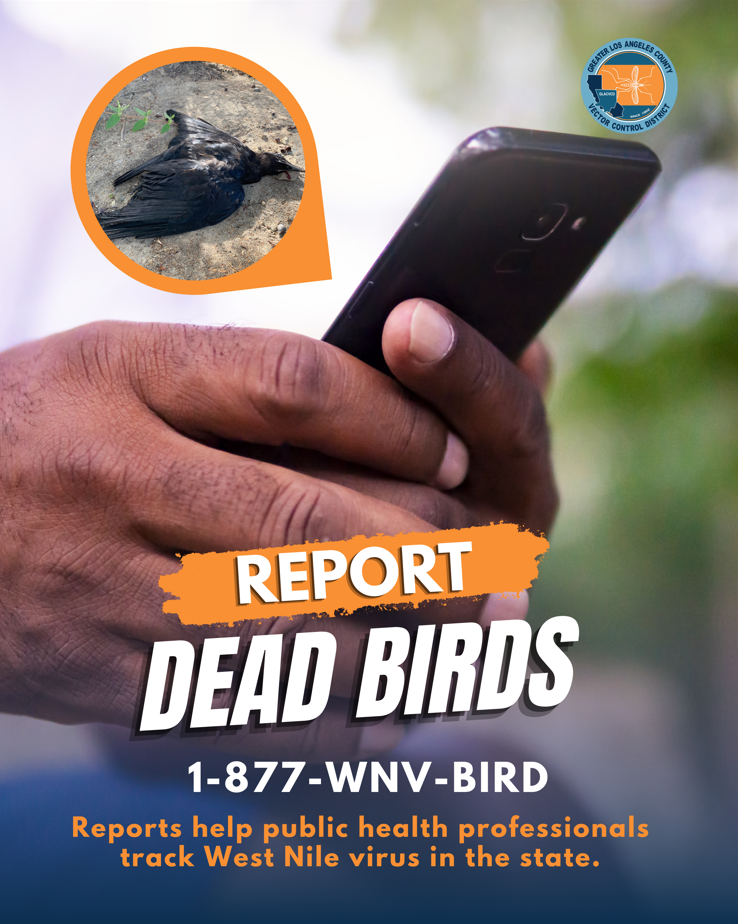
Found a dead bird?
Several bird species can die after becoming infected with West Nile virus, making them an important early warning sign of virus activity. The California Department of Public Health coordinates a statewide dead bird surveillance program to help monitor the spread of the virus.
If you find a dead bird, report it online or call the West Nile Virus Dead Bird Hotline at 877-WNV-BIRD (877-968-2473).
Expert's Corner: Myth or Fact?

"The Bucket of Doom"
You've probably seen the viral "Mosquito Bucket of Doom" on social media. Mosquito dunks can be an effective way to control mosquito larvae when used as directed in existing water sources, such as rain barrels or fountains. However, because the dunks don't attract mosquitoes, creating new containers of water isn't recommended.
The best way to reduce mosquitoes is still to dump and drain standing water around your home every week. Need help from the experts? Submit a service request, and our team will be happy to help.
Meet the People Protecting Public Health in Your Community

he Team Behind Mosquito Surveillance
While most people swat mosquitoes, our Scientific-Technical Department studies them. They're one of the few groups you'll ever meet who get excited about finding one! Through field surveillance and laboratory research, they monitor mosquito populations, track mosquito-borne disease activity, and evaluate innovative control methods that help guide the District's mosquito control efforts.Our Vector Ecologists and Vector Field Assistants are responsible for:
Mosquito, black fly, and midge surveillance
Setting and collecting mosquito traps
Identifying mosquito species
Monitoring mosquito-borne disease activity & pesticide resistance
Leading our Sterile Insect Technique (SIT) pilot program
If you see them around, don't be shy! They're always happy to talk mosquitoes, black flies, and midges.
Kind regards,
Greater Los Angeles County Vector Control District
Your Trusted Mosquito Experts Since 1952


Comments